Storming the Walls: Heidelberg 1622
A Scenario for While the Devil Rules
This scenario was written as part of a mapless mini-campaign conducted using the Siege! app from Application of Force, and is designed to be played with the While the Devil Rules tabletop game, but is probably easily translated to other systems such as "Pike & Shotte" or "In Deo Veritas". The game apps linked to here are available free of charge. A description of the campaign set-up can be found here.
Heidelberg was besieged in 1622, by Imperialist and Spanish forces under Tilly and Cordoba, and was defended by a largely English garrison commanded by Sir Gerald Herbert. After 11 weeks, the city was taken by storm, and Sir Herbert was killed during the fighting. This scenario depicts an assault against the western walls, along the banks of the Neckar, which is not historically accurate (as far as we know), but makes sense in terms of the campaign game.
The battlefield is a 4' x 6' tabletop. The map below shows the basic terrain features. The river is considered impassable, and does not even need to be represented (it is just a board edge). The hills and woods are rough and provide soft cover. The attacker's lines (dotted brown line) are the entrenchments, providing hard cover and costing infantry 1" of movement and mounted or light artillery twice that. The grey fortress works are fortifications in game terms, and have a ditch in front of them, so anyone attacking frontally will be considered down-slope of their opponent (this is significant in melee). It is assumed that sally ports exist as necessary for troops inside to exit the fortress as needed (these would be like passing through a narrow opening, so will slow movement accordingly).
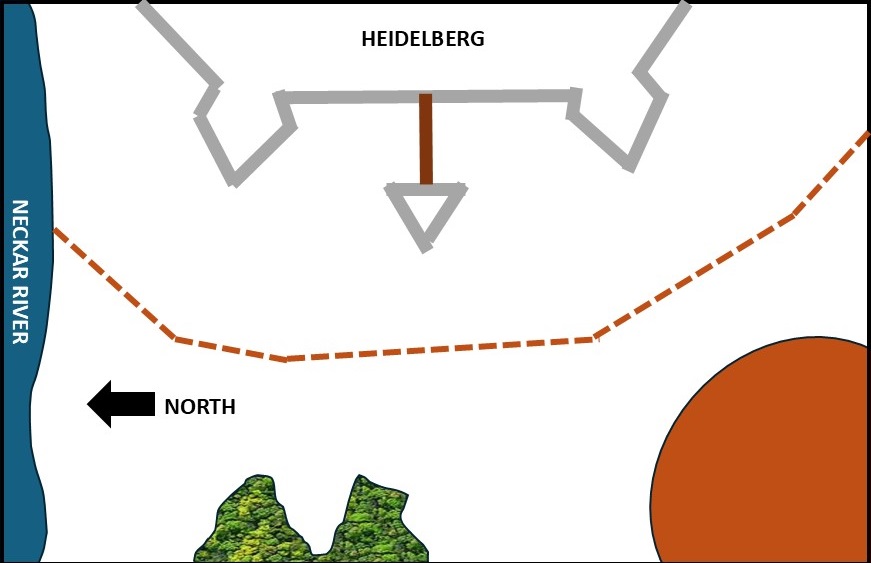
The Protestant forces will set up inside the fortifications. Only two bases will fit into the demi-lune. Infantry set up along walls or entrenchments which is in contact with artillery is assumed to be in a supporting position, meaning that any assault on either unit must first fight the infantry. Imperialist forces will set up in or behind their works (west of the dotted line).
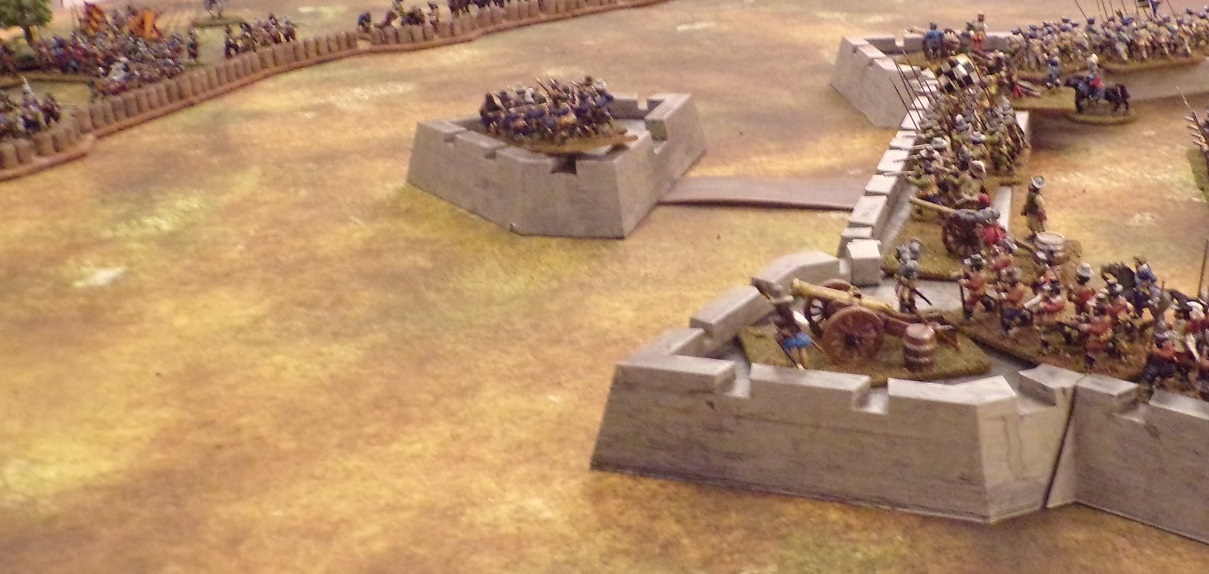
The picture below shows how the table is set up - the fortress itself was 3D printed off some models from Thingiverse, with a bit of editing. All the gabions likewise. (This is pretty bare-bones, but the ditch and other aspects could be added for a better look.)
Command: 3 ordinary generals, one of whom is the commander-in-chief (Tilly). Units may be assigned to commands as desired.
Veteran Foot: 3 Veteran Tercios, each 6 bases.
Siege Guns: 2 Heavy Artillery units.
Battalion Guns: 2 Light Artillery units.
Assault Party: 1 2-base unit of Sword & Bucklermen.
Assault Party: 1 2-base unit of Commanded Shot.
Dragoons: 1 unit (single base equivalent).
Cuirassiers: 1 2-base unit.
Harquebusiers: 2 2-base units.
Army Breakpoint: 33
Command: 2 ordinary generals, one of whom is the commander-in-chief (Sir Gerald Herbert). Units are assigned to them as desired before the start of play, but each must have direct command of at least 4 units.
English/Scottish Foot: 1 Veteran Dutch Battalion.
German Protestant Foot: 3 Dutch Battalions.
Heavy Guns: 1 base Heavy Artillery.
Medium Guns: 1 base Medium Field Guns.
Light Guns: 2 bases Light Artillery (separate units).
Musketeers: 1 2-base Commanded Shot unit.
Army Breakpoint: 18
The game is played until one army or the other is broken. Imperialists must have at least one unit inside the main fortress (this can be an occupying move after a successful assault which destroys its enemy). The game is "sudden death" - as soon as a breakpoint is reached, the game ends. There are no ties - if the Imperialists do not win, the Protestants do (it's a siege!).